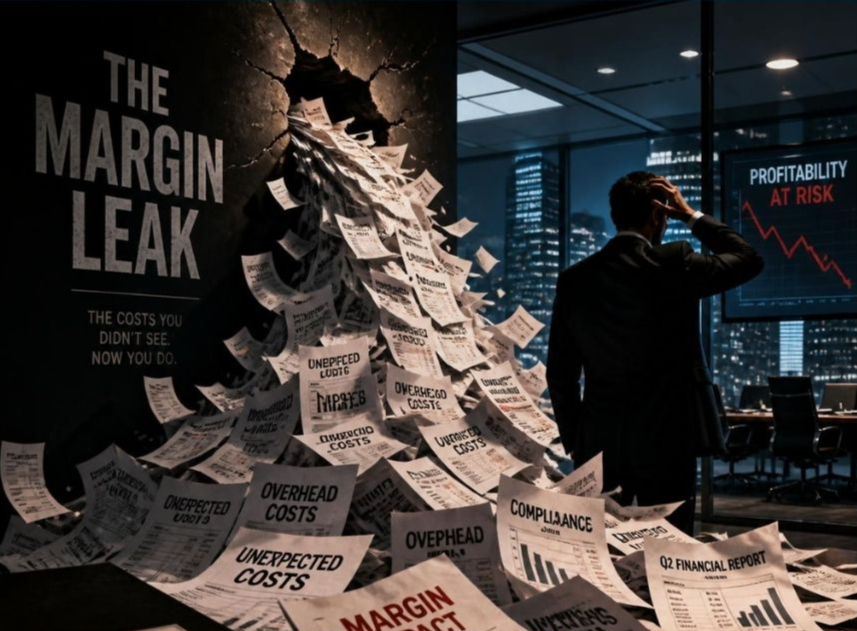
Signs Your Business Is Financially Leaking Money

Most business owners don’t lose money in one big dramatic event, they lose it slowly. A few missed invoices here, a miscategorized expense there, a subscription nobody remembers signing up for. Over time, these small gaps turn into serious financial leakage that quietly eats into profits.
The challenge is that revenue can still look strong on the surface. Sales may be growing, clients may be coming in, and operations may feel busy but underneath, cash is slipping away. Recognizing the warning signs early is what separates businesses that scale from those that constantly feel like they’re “working hard but not getting ahead.”

1. Your profits don’t match your revenue
One of the clearest signs of financial leakage is when revenue is growing, but profits are flat or worse, shrinking. If more money is coming in but your bank account doesn’t reflect that growth, something is off.
This often points to uncontrolled expenses, underpriced services, or inefficient operations. Without accurate financial tracking, it’s easy to assume growth is happening when in reality, costs are growing just as fast (or faster) than income.
2. You don’t have a clear picture of cash flow
Cash flow is the lifeblood of your business. If you’re frequently surprised by low bank balances or unsure how much cash is actually available, that’s a major red flag.
Businesses often “leak” money when timing isn’t tracked properly like paying bills before collecting receivables, or failing to follow up on overdue invoices. Even profitable businesses can run into trouble if cash flow isn’t actively monitored.
3. Expenses feel inconsistent or unclear
If you ever look at your bank statement and think, “What is this charge?” or “Why are we paying for this?”, you’re likely experiencing expense leakage.
Common culprits include:
Forgotten subscriptions
Duplicate software tools
Unused services still being billed
Personal expenses mixed with business spending
Without structured bookkeeping, these small inefficiencies pile up quickly.
4. You’re not regularly reviewing financial reports
If financial reports are only looked at during tax season (or not at all), you’re operating blind for most of the year.
Monthly profit and loss statements, balance sheets, and cash flow reports are not just formalities, they are decision-making tools. Without them, it’s impossible to spot trends, control costs, or identify where money is being lost.
5. Invoices are going unpaid or delayed
Delayed or uncollected payments are one of the most common sources of financial leakage. If you’re doing the work but not consistently collecting payment on time, you’re essentially providing interest-free financing to your clients.
Even a small number of overdue invoices can create significant cash flow strain over time.
6. Pricing hasn’t been reviewed in a long time
Many businesses undercharge simply because they haven’t revisited their pricing strategy in years. As costs increase, outdated pricing structures quietly erode margins.
If you’re busier than ever but not more profitable, pricing is often part of the problem.
7. You rely on guesswork instead of data
If major decisions like hiring, expanding, or investing in tools are made based on “gut feeling” instead of financial data, your business is vulnerable to leakage.
Without accurate accounting, even strong intuition can lead you in the wrong direction.
Why better accounting solves the problem
Financial leakage is rarely about one big mistake. It’s about visibility. When your books are incomplete, delayed, or disorganized, you lose the ability to see what’s actually happening in your business.
Better accounting brings structure and clarity:
Expenses are properly categorized
Cash flow is tracked in real time
Reports are accurate and consistent
Profitability becomes measurable, not assumed
Decision-making becomes data-driven instead of reactive
In short, good accounting doesn’t just record what happened, it helps prevent unnecessary losses from happening again.